Showing posts with label Japan. Show all posts
0 com

If I could do it all over again

(Pico Iyer on why we travel)
I remember, in fact, after my first trips to Southeast Asia, more than a decade ago, how I would come back to my apartment in New York, and lie in my bed, kept up by something more than jet lag, playing back, in my memory, over and over, all that I had experienced, and paging wistfully though my photographs and reading and re-reading my diaries, as if to extract some mystery from them. Anyone witnessing this strange scene would have drawn the right conclusion: I was in love.
If I could do it all over again, it would be different.
0 com

Feeling Tokyo

When I think of Tokyo and let the feeling of the city fill me up, my eyes are flooded by a single image.

Um, if you could superimpose the ugly text out of the damned thing...

In my heart, this is what Tokyo looks like. Rather, this is what Tokyo feels like. Still, detached, its personality neither warm nor cold, oblivious.

Another thing that comes instantly to the mind when I think of Tokyo is what is known as the pillow shot. Not unlike the shot on the postcard, a pillow shot is a still shot of an inanimate object - exemplified in Yasujiro Ozu's films. It is inserted to pull the viewer out of presently unfolding scenes for a contemplative moment of silent stillness, as if to cushion the impact of a preceding scene or to allow the audience a moment's breather to think - or not think - about all the scenes that were over and all the scenes that were yet to come. That contemplative gap, a sort of suspended state between thinking and not thinking, consciousness and unconsciousness - that to me is Tokyo.

There is just something mysterious about the place that can't seem to be unlocked, and I have no idea whether the mystery is deliberate or not. The mist in the picture is everything.
0 com

MYTH NUMBER ONE

We kind of all thought the average Japanese dude would look like DIS.


(Har har, see how I snuck in a picture of Toma? You are welcome.) Turns out, no. LE SAD.
0 com

Maps on Steroids

Tomorrow, I plan to:
  1. Write a Japan post
  2. Work on the itinerary for Kyoto and Nara
  3. Resolve our accommodation issue for Tokyo
Err, that's in increasing importance. Our accommodation issue is really no issue at all - we're just trying to figure out which one of two hotels is located at a better spot. Last week, I tried to settle this at work, thinking it would take 5 minutes to decide. Google some subway route maps, how hard is it, right? Well, right, unless the maps look like this:


I couldn't stop laughing for 20 seconds when I first saw these things. I mean, I knew it was going to be crazy but this is CRAZY ON CRACK.
0 com

Who loves trivia?

I do, I do!!!

- It is believed that Japan has been inhabited since the Paleolithic era, a whopping 35,000 years before the Common Era. To put things in perspective, the woolly mammoth only became extinct in 2000 BCE.

- This has been ascertained through archaeological digs, which have uncovered polished stone implements and tools emblematic of and commonly used during the late stone age.

- This massive period of time is known as Japan's prehistory, which precedes its ancient history. In other words:

Prehistory (stone age) --> Ancient history (Kofun onwards) --> Modern history (Meiji and beyond) --> Postwar / Contemporary history


- During Japan's prehistoric period, the Japanese archipelago was still attached to the continent. The island of Japan, as we know it today, only separated from the continent around 11,000 BCE.
0 com

WARNING: This is going to be long

When I decided to do these weekly features on Japan ahead of my trip, I thought it would be a great way to revisit all the wonderful things I learnt in school about Japanese history. So last week as I prepared to write draft think about this second post, I sat myself down and dug into the archives of my brain. What did I learn in school about Japanese history?

Let's see. Giant keyhole-shaped burial plots dating back to the 3rd century? Legendary samurai who could jump ten feet into the air?? Ooh I remember watching a short video of a fight scene in Yoshitsune, starring Hideaki Takizawa (papa~), when we were learning about the Tokugawa Shogunate. The lecturer asked whether we were able to keep track of Yoshitsune amidst all the fighting men and a girl answered, "Yeah, he was the CUTE ONE."

Ah, university. All that learnin'.

Anyway, that was the only Japanese history class I took - in the first semester of my first year. Normally I would ask you to cut me some slack considering how long ago that was but let's not kid ourselves, this was probably all I knew way back then, too.

Nevertheless! The giant keyhole-shaped burial plots are no joke. Very real, very important in Japan's ancient history, and as such our topic for today. Let's begin!

Japan's ancient history essentially begins during the 3rd century, with a period known as the Kofun period. The era takes its name from kofun, which are these massive keyhole-shaped burial mounts that exist all over Japan. Kofuns and the Kofun period date back to the 3rd to 6th century CE; their epic size is important because it suggests the presence of a human society organised according to a clear social hierarchy, where people were differentiated between who was important - and worthy of such magnificent burial rites - and who was not.

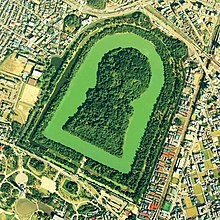
And when I say massive, I mean MASSIVE. Behold a satellite picture of the largest kofun in Japan, the Daisenryo Kofun found in Osaka, built during the 5th century:


No match for the Egyptian pyramids perhaps, but still. Buried in style, yo!

The VIPs who enjoyed the particular privilege of being laid to rest in such prime real estate were of course the most important clan leaders of the time, who ruled parts of Honshu. Among them were leaders who went on to become the emperors of ancient Japan. For this reason, visitors are actually barred from kofun by the Imperial Household Agency and up until recently, archaeologists were not allowed inside, either.

That said, kofun of more modest sizes have also been discovered, so it is believed that this particular style of burial was not exclusive to the elite and indeed must have been a common for whoever could afford it. And perhaps because of how commonplace the kofun was, or perhaps because of how awesomely gargantuan some of them were, the period between the 3rd and 6th centuries CE was named after these things, these things where the dead are laid to rest, and called the Kofun period.

Mor-bid!

Lasting a very respectable three centuries, the Kofun period was the beginning of Japan's ancient history as it was the first time history was recorded for posterity - before that, human life had existed but because no historical record was kept of those societies, they only qualify as 'prehistoric' societies.

The three centuries of the Kofun period represent a critical transitional period in Japanese history. During this time, Japan went from being a disorganised and random horde of people living in the archipelago, to an organised society, enjoying the wonderful pleasures of politics, an economy, the military and culture. Polities emerged, along with clans, courts, expanded territories, soldiers, aristocrats, and language. As these elements developed, Japan evolved to become a more cohesive state - what I like to call the growing-up years of a civilisation.

Now, why is any of this important, you ask? Quite simply, because the Kofun period is the beginning of Japan's history; its society is an ancient precursor to what we know today as Japan. But most significantly, the Kofun period is important because it is during this time that the Japanese Imperial House emerged in history. Not an imperial house, mind you - the Japanese Imperial House. With a singular, definite article. Remember I mentioned that visitors are barred from kofun? Isn't that odd considering millions of people visit, say, the pyramids - also an ancient burial site? I mean, 300 CE is a really long time ago right, why so touchy? The reason is no less than this: The kofuns were the final resting places of the ancestors of Japan's current royal family.

YOU HEARD ME RIGHT. The Japanese monarch that sits on the Chrysanthemum Throne today traces his ancestry to the emperors of the Kofun period, which existed more than 1,700 years ago. And get this, the line is unbroken. The Throne has not changed hands since 300 CE. Is your mind blown? Tell me your mind is blown. Dudes, the imperial seat has been warmed by a bloodline carrying the same strand of DNA since 300 years after the existence of Jesus Christ. The extended family has passed the throne, from brother to brother, father to son, son to mother, mother to grandson, so on and so forth throughout a history that spans the Roman Empire, the Islamic Empire, the European Middle Ages, the European Renaissance, the Age of Discovery, the founding of the New World, the French Revolution, the American Revolution, the Industrial Revolution, the First World War, the Second World War, the Cold War, and the 20th century.

HELLO????

This is absolutely incomparable. For sure monarchies still exist everywhere, but a lineage that has continued unbroken and stayed on the throne since the ROMAN EMPIRE and that will continue to reign for generations to come? That is truly astounding. As for how they stayed in power - that's an excellent question that I will return to in the coming weeks. As the history of ancient Japan unravels we will see the changing role of the imperial seat, and how it survived through the years.

So! What's next??? By now, you should have figured out that I've decided to take a broad chronological approach to the history posts. Thankfully, what comes a little after the Kofun period is slightly less obscure and much more relevant to our trip in November - the Nara period. In fact, chronologically speaking, the history that follows hereafter takes us through all the places we're visiting with the exception of Osaka:

Prehistory --> Kofun period --> Asuka period --> Nara period --> Heian (Kyoto) period --> era of the feudal states --> Kamakura period --> Kemmu Restoration --> Muromachi period --> Sengoku period --> Azuchi-Momoyama period --> Edo (Tokyo) period) --> Meiji Restoration in 1868

This pretty much simplifies things for me. Obviously I'm not going to go into all of that, but naturally, we're talking about one post each for the Nara, Heian, and Edo periods. Which means...at least three more weeks of history!! Whee!!!

So I leave you with that tantalising thought, and also with this. The video we saw of cute Yoshitsune (Takki!!) doing the samurai jump in, like, twenty different kinds of slow motion during five minutes of fighting. Enjoy:

4 com

Japan 101 - Geography!

Welcome, cats and kittens! Today we learn the basics about Japan and the places I will be visiting, which means it's time to break out the ole geography textbooks. Or what I like to call, Wikipedia. Ready? IKIMASHOU!

Japan is made up of more than six thousand islands but the largest four account for approximately 97% of the country's land mass. They are:
  1. Honshu - the main island;
  2. Hokkaido - north of Honshu;
  3. Kyushu - 'Nine Provinces', south of Honshu; and
  4. Shikoku - 'Four Provinces', east of Kyushu.
In November, I will be travelling to four places - Tokyo, Nara, Kyoto and Osaka. These are all located on the main island, Honshu.

For the purposes of government and administration, Japan is divided into eight main regions. Hokkaido, Tohoku, Kanto, Chubu, Kansai, Chugoku, Shikoku, and Kyushu & Okinawa. While Tokyo belongs to the Kanto region, Nara, Kyoto and Osaka all fall within the Kansai region.

These eight regions contain a total of 47 administrative prefectures, which are classified under what is known as the todofuken system. This explains why places are sometimes referred to with a suffix, such as Fukuoka-ken. For the places I'm visiting: Tokyo-to is a to - the only to in Japan- and Hokkaido is the only do. Osaka and Kyoto are the only fu; Nara, along with all the remaining prefectures in Japan, are ken.

What do todofuken mean, you ask. Actually all four mean 'prefecture' - the difference is in what kind of prefecture.
To is used to describe a major and important prefecture, so Tokyo-to basically means 'Tokyo the metropolis'. The official translation of Hokkai-do is 'North Sea Circuit', where do literally means 'way' or 'road'. (It's a pretty sweet name really, calling to mind the idea that Hokkaido was some sort of Northern gateway or funnel into Japan.) Fu means 'urban prefecture', which means Osaka and Kyoto were...urban prefectures, and, finally, ken simply means prefecture. No fancy names for the non-fancy places, I suppose!

If you haven't fallen over with boredom by now, you might ask what the purpose of todofuken is. Why, I was just getting to that! During the Edo and Meiji period, being a fu or a ken meant you were governed in different ways. Idiot's Guide version: Prefectures classified as fu were the important urban centres and therefore governed directly by the central feudal government (known as the shogunate) while prefectures classified as ken were the not-so-important unwanted children governed by local townships. Today, all the prefectures are governed in the same way regardless of whether they are to, do, fu, or ken, so there is actually no current purpose for the todofuken classifications. But they are still retained for...errr...sentimental reasons?

Hey! Guys! Do you think Japan is some kind of super traditional society???

Alright so, TO RECAP: Come November, I will be touring Honshu, where I will first fly into Tokyo-to in Kanto, before making my way to Osaka-fu, Nara-ken and Kyoto-fu in Kansai.

Oh snap! Full marks to me!!!

Alright, alright. So this is of no use whatsoever to a practical traveller. But hey, when I'm lost in the streets in Osaka with nary an idea how to get back to my hostel, at least I'd be armed with a very specific understanding of the geography as well as etymological origin of the name of the prefecture in which I am lost. That's right, suck it, haters!

Next week: MORE useless information about whatever I feel like writing. Can't wait!